

Key points
- The Butterfly Hug is a simple self-soothing technique used in trauma therapy.
- It involves gently tapping your arms alternately while your arms are crossed over your chest.
- The rhythmic tapping can calm the nervous system and reduce anxiety.
- Many people find it helpful when they wake in the night and their mind won’t settle.
- It is easy to learn and can be used anywhere.
If you’re awake and your mind won’t settle
If you wake in the night and your mind starts racing, your body can quickly join in.
Your heart may beat faster.
Your breathing becomes shallow.
Your thoughts start going round in circles.
At that point, trying to think your way back to sleep rarely works.
Instead, it can help to calm the body first.
One simple technique I often suggest is called the Butterfly Hug.
It takes less than a minute to learn and you can do it quietly in bed.
It sounds almost too simple to work — but simple rhythmic movements can calm the nervous system surprisingly quickly.
Try this now
“Can’t sleep right now? Try this for one minute before you read the rest.”
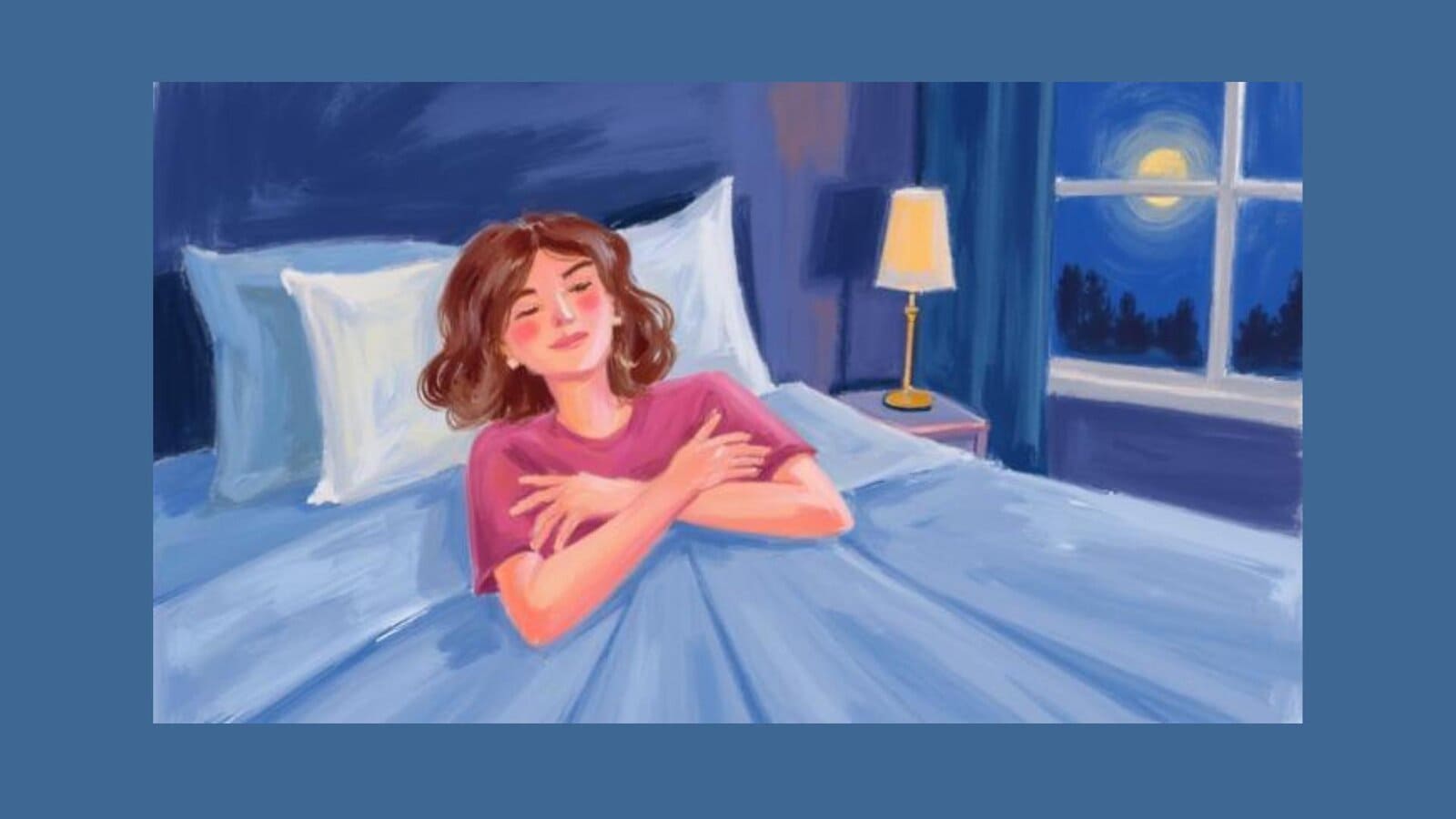
- Cross your arms over your chest.
- Rest your hands just below your collarbones.
- Gently tap your arms left, right, left, right.
- Keep the tapping slow and steady.
- Let your breathing slow down naturally.
Do this for a minute or two.
That’s all.
No special breathing.
No concentrating.
Just gentle tapping.
Many people notice that their body settles first, and the mind follows.
Grounding Technique for Anxiety and Overwhelm
The Butterfly Hug is sometimes described as a grounding technique.
Grounding techniques help bring your attention back to the present moment when anxiety, memories, or strong emotions begin to take over.
The gentle tapping rhythm gives the mind something simple to focus on and helps the nervous system settle.
You may find it helpful when:
- anxiety suddenly rises
- you feel emotionally overwhelmed
- difficult memories surface
- you need to calm yourself quickly
Many people like it because it is discreet and easy to do anywhere — even sitting quietly in a chair or lying in bed.
Why this can help
The Butterfly Hug uses something called bilateral stimulation.
That simply means stimulating the left and right sides of the body in a steady rhythm.
This kind of rhythmic movement can help the nervous system shift out of stress mode and back toward calm sleep..
You may notice:
- your breathing slowing
- your muscles relaxing
- your thoughts becoming less intense
It doesn’t force sleep.
But it often takes the edge off the stress response, which makes it much easier for sleep to return naturally.
Where the technique comes from
The Butterfly Hug was developed by Lucina Artigas and Ignacio Jarero while working with survivors of a hurricane in Mexico in the late 1990s.
It later became part of EMDR therapy (Eye Movement Desensitisation and Reprocessing) — a well-established therapy used for trauma.
Unlike many EMDR techniques, the Butterfly Hug can be done safely on your own, which is why it has become widely used as a simple self-calming tool.
What research suggests
Researchers studying the Butterfly Hug and similar EMDR techniques have found encouraging results.
Brain imaging studies show that the technique can reduce activity in the amygdala, the part of the brain involved in fear and threat responses.
Other studies suggest it may help reduce anxiety and emotional distress by helping the brain move back into a more regulated state.
Research in this area is still developing, but many therapists and trauma specialists now use bilateral tapping techniques regularly because they are simple, safe and often effective.
When people use it
People often find the Butterfly Hug helpful when:
- they wake in the night feeling anxious
- their mind is racing
- emotions feel overwhelming
- painful memories surface
- they need to calm themselves quickly
It is one of those techniques that sounds almost too simple to work.
But simple rhythmic movements can have a surprisingly strong calming effect on the nervous system.
A helpful tip
If you try the Butterfly Hug at night, keep the tapping very gentle.
Almost like a quiet rhythm.
Some people also find it helpful to think something reassuring, such as:
“I’m safe right now.”
“My body knows how to sleep.”
There’s nothing to get right.
Just tap slowly and let your body settle.
A One-Minute Version for When You Wake at Night
If you’re reading this at 2am and your mind is racing, try this shorter version.
Cross your arms over your chest and begin gently tapping left and right.
Let the tapping become a slow rhythm.
You don’t need to count or breathe in any special way.
Just tap slowly and notice the sensation of your hands on your arms.
If your thoughts wander (and they normally do), simply bring your attention back to the tapping.
After a minute or two, pause and notice your body. Sleep can follow naturally once your body settles.
A One-Minute Version for When You Wake at Night
If you’re reading this at 2am and your mind is racing, try this shorter version.
Cross your arms over your chest and begin gently tapping left and right.
Let the tapping become a slow rhythm.
You don’t need to count or breathe in any special way.
Just tap slowly and notice the sensation of your hands on your arms.
If your thoughts wander (and they probably will), simply bring your attention back to the tapping.
After a minute or two, pause and notice whether your body feels a little calmer.
Often it does.
Sleep may follow naturally once your body settles.
Explore
- Sleep & Trauma
- Sleep & Pain
- Learning to Settle a Busy
- Anxiety / insomnia page
EMDR Association – https://map.emdrassociation.org.uk/wp-content/uploads/2020/04/butterfly-hug.pdf