

Key Takeaways
- Sleeping next to someone who snores is extremely common
- Irritation often wakes you more than the sound itself
- Your brain can learn to categorise snoring as background noise
- Shifting your response can help you fall asleep more easily
- Some snoring should be medically checked
- Hypnotherapy and NLP can reduce both irritation and night-time disturbance
Introduction
“Laugh and the world laughs with you,
Snore and you sleep alone.”
— Anthony Burgess
There’s a lot of truth in that, don’t you think?
IIf your partner snores and you’re lying awake feeling irritated, exhausted and slightly murderous, you are not alone. Sleeping next to someone who snores is one of the most common reasons couples struggle with sleep — and it doesn’t always mean you need separate bedrooms.
So many couples end up drifting into sleeping apart, creeping off to the spare room, or going to bed at different times — simply because of snoring. When you’re already tired, tolerance is not at its best.
Snoring is often fixable — properly fixable — if you look beyond the shelves in your local chemist. But sometimes, while you’re sorting out the cause, you simply need to sleep through it.
Let me tell you something slightly humbling.
I was in hostel accommodation in Spain in 2018 on a meditation retreat. I had my earplugs. I thought I was well prepared. So you can imagine how mortified I was to be gently asked to turn over.
I had absolutely no idea I snored.
Most of us don’t.
Most rooms on that retreat had at least one snorer in them. It is incredibly common.
A Different Way to Relate to the Noise
Here’s a technique I have used myself and shared with clients.
Rather than fighting the sound, we change our relationship to it.
First, remember other times in your life when you learned to sleep through noise:
- The television in the other room
- People coming home late
- A hotel near an airport
- A flat by the railway line
- Building works starting at an ungodly hour
- Delivery vans
- Emergency vehicles
- That motorbike that accelerates at 2am
- Dogs barking
- The birds’ chorus at 4am in summer
At first, those sounds were intrusive. Then — gradually — your brain decided they were safe. And once something is labelled safe, you stop reacting to it.
Now, just for a moment, think of cicadas on a warm night somewhere beautiful.
That lovely stopping and starting rhythm.
The air still warm on your skin.
Nothing to do. Nowhere to be.
Stay with that memory for a few breaths.
If you listen closely, cicadas are not entirely dissimilar to snoring. A rising and falling rhythm. A repetitive pulse.
When the brain decides a sound is part of the background, it blends away.
Often it isn’t actually the sound that keeps you awake. It’s the running commentary in your own head.
“He’s doing it again.”
“I’ll be exhausted tomorrow.”
“This is so unfair.”
Those thoughts wake you up far more effectively than the sound itself.
So instead, you might experiment with this:
“Ah. The cicadas.”
You are not pretending it isn’t happening.
You are simply choosing not to fight it.
And as you breathe slowly and allow your jaw and shoulders to soften, you can let the sound be exactly as it is — while you relax anyway.
It sounds almost too simple. But it works because you’re helping your system settle so it stops reacting as if something is wrong.
You’re not trying to make the noise disappear.
You’re helping yourself stop bracing against it.
That’s different.
When Snoring Needs Proper Attention
That said, some snoring does need investigating.
Very loud snoring with pauses in breathing, gasping, or excessive daytime sleepiness can indicate sleep apnoea and should be checked with a GP.
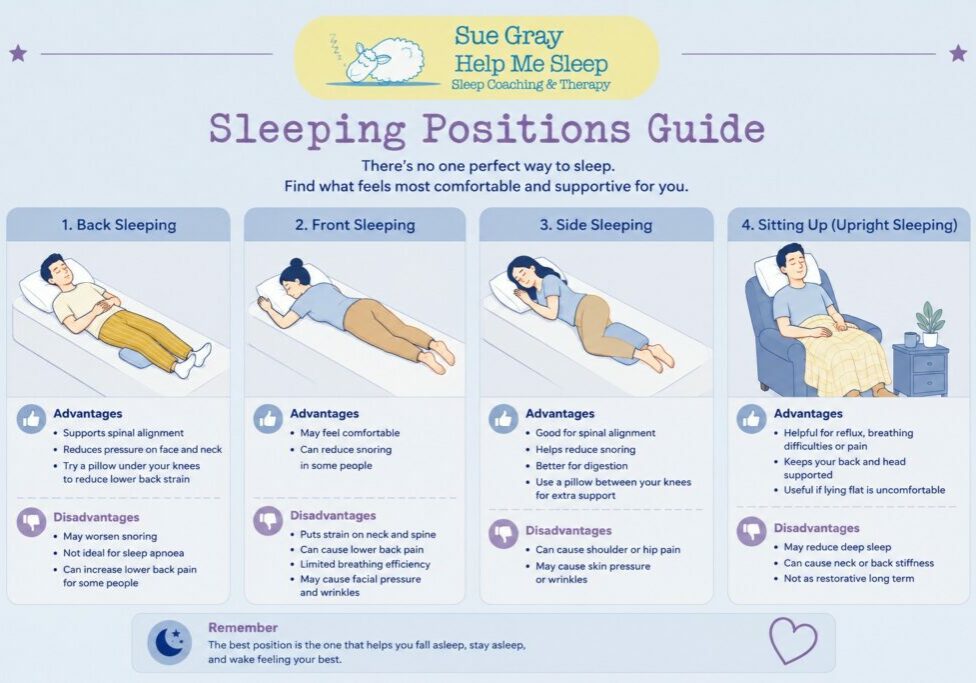
Snoring linked to weight gain, alcohol in the evening, reflux, blocked nasal passages or sleeping on the back can often improve quite quickly once the cause is addressed.
And yes — I do help people reduce snoring itself.
Using hypnotherapy and NLP, we can:
- Help someone become more aware of rolling onto their side
- Reduce stress patterns that worsen snoring
- Ease night-time mouth breathing habits
- Calm the irritation response in the partner
It does not usually take many sessions.
We’re not trying to make you oblivious to the world.
We’re simply helping your system settle so it can sleep even when conditions aren’t perfect.
What About Sleeping Separately?
Sometimes couples choose separate rooms. Sometimes it’s temporary. Sometimes it’s long term.
There is no moral high ground here — just what works for the two of you.
Good sleep matters.
Resentment at 3am rarely improves a relationship.
Before you banish your partner permanently though, it may be worth trying a shift in how you respond. Often that alone changes more than you expect.
And finally, because humour helps:
“A marriage is always made up of two people who are prepared to swear that only the other one snores.”
— Terry Pratchett
If snoring is affecting your sleep, your patience, or your relationship, you’re very welcome to get in touch.
When you’re fed up with counting sheep, talk to me — I’ll help you sleep.
Explore Further
Sue Gray